

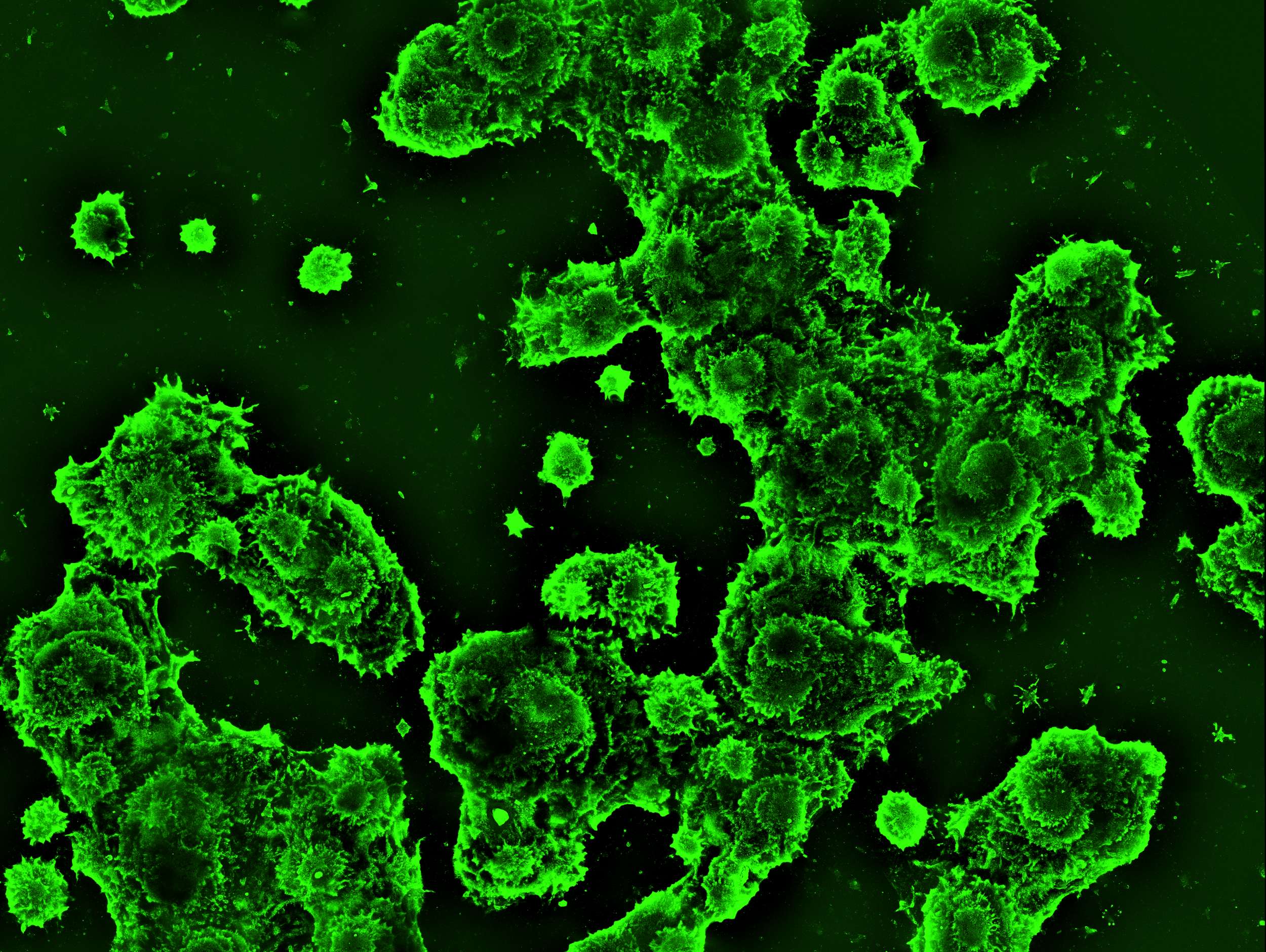
Specific ECM architecture within stem cell niches promotes high AKT signaling to enable stem cells to be insulated from ERK signaling dynamics.
Stem cells in the colon must be maintained even in the presence of constant pro-differentiation signals. This requires high AKT and suppression of ERK pulses within the stem cell niche. We have now shown that AKT suppresses ERK through phosphorylation of upstream MAPK protein, RAF-1, at serine 259. This ‘ERK checkpoint’ maintains proper signaling to keep the stem cell niche preserved. However, it does not answer the question of how AKT is hyperactivated in the stem cell niche specifically. Laminin-332 is a extra-cellular matrix (ECM) component that is high enriched in the stem cell niche of the colon. Data in cell lines have shown that migrating cells can pattern this ECM into specific architectures that impact cell signaling. Lam-332 is secreted by epithelial cells and mesenchymal cells (like fibroblasts) but can only be patterned by stem cells! We believe that the stem cells specifically shape and structure Lam-332 into a rosette pattern. This pattern then binds the alpha 6/ beta 4 integrin heterodimer, which can activate FAK, SCR, and finally AKT. We hypothesize that the patterning of ECM architecture by stem cells creates a specialized niche that allows these cells to hyper-active AKT to promote their maintenance.